Tent Series: Keliy Anderson-Staley, Preston Gaines, and Dario Robleto
This season, the Tent Series returns with three new artworks that engage with cultural memory, technology, and what we owe to those who will inherit what we leave behind. Invited to create large-scale murals, sited on the PCF Tents in the heart of campus, local artists Keliy Anderson-Staley, Preston Gaines, and Dario Robleto offer visual invitations to consider archives as a living, generative material rather than a fixed record. Read on to learn more about each work. Join us on September 10, 6 - 8 pm to hear from the artists and celebrate the new installation.
Keliy Anderson-Staley
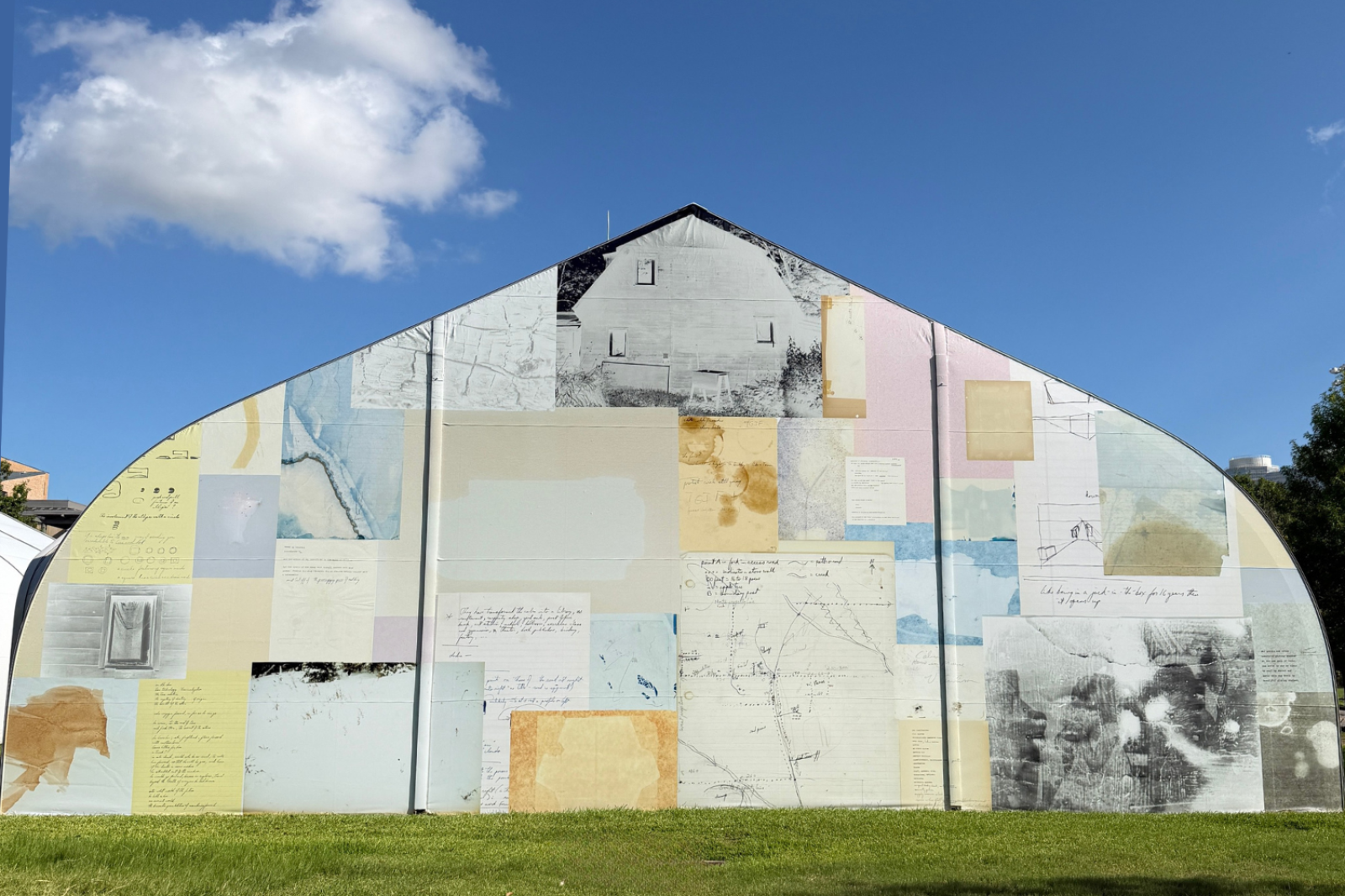
Wilderness no longer at the edge of things, 2026
Printed vinyl, HD video with sound, 25:04 minutes
Commissioned by Moody Center for the Arts, Rice University, with additional funding to the artist from the City of Houston through the Houston Arts Alliance
Keliy Anderson-Staley’s “Wilderness no longer at the edge of things” emerges from an expansive archive centered on the rustic homestead in Maine where she and her siblings were raised off the grid. Accumulated from letters, drawings, and other ephemera created by her father, alongside photographs Anderson-Staley made across decades, the archive chronicles the family, the wooded landscape they inhabited, and their experience of rural life. Rather than preserving it as a historical record, the artist approaches this archive as generative material—scanning and rephotographing images, printing over original documents, and incorporating elements into entirely new works. Through these interventions, the archive becomes a layered record in which inherited, self-authored, and reworked forms coexist as Anderson-Staley revisits and reframes the family histories it contains.
For the Tents Series, Anderson-Staley extends this body of work into a two-part installation. During daylight hours, the tent façade presents a large-scale collage of scans of the archive, including notes written by the artist’s father and a hand-drawn map of the Maine property, nearby landmarks, and the stream the family crossed to reach the cabin at its center. After sunset, the tent becomes a screen for a projected video in which the artist animates the archive across a loose chronology, moving from the construction of the family cabin in the late 1970s through the decades of life that unfolded around it, before culminating in the burning of the structure by new owners in 2019.
Built by her parents in pursuit of an idealized life off-grid, the cabin—without running water or contemporary conveniences—becomes the enduring subject by which Anderson-Staley returns to the world that shaped her early years. Drawing largely on photographs she made in high school, college, graduate school, and the present day, “Wilderness no longer at the edge of things” explores the ambitions, demands, and contradictions of that life, and the distance between her parents’ dream and the realities lived by the family. By bringing her father’s materials into relation with her own decades of documentation—and continually reworking both through the lens of her photographic practice—Anderson-Staley becomes the primary author of an evolving archive through which the story of the homestead is reclaimed and newly understood.
About the Artist
Keliy Anderson-Staley (b. 1977, Boston, MA) is a Houston-based photographer whose work explores portraiture, material histories, and photographic processes. Her work has been exhibited widely at institutions including the Smithsonian’s National Portrait Gallery, Washington, DC; The Bronx Museum of the Arts, NY; and Akron Art Museum, OH; and her works are held in the public collections of the Library of Congress, Washington, DC; Museum of Fine Arts, Houston, TX; and the Portland Art Museum, Portland, ME, among others. In 2022, Anderson-Staley was awarded the Guggenheim Fellowship, and in 2019, she completed a major public art commission for Houston’s George Bush Intercontinental Airport. She holds a BA from Hampshire College, Amherst, MA, and an MFA from Hunter College, New York, and is Professor of Photography/Video at the University of Houston School of Art.
The artist would like to acknowledge Drew Bacon for video editing; Finnian Anderson-Williams for original piano music; and Matthew Williams and Zoreh Bakhshi for their ongoing contributions to the project.
Preston Gaines
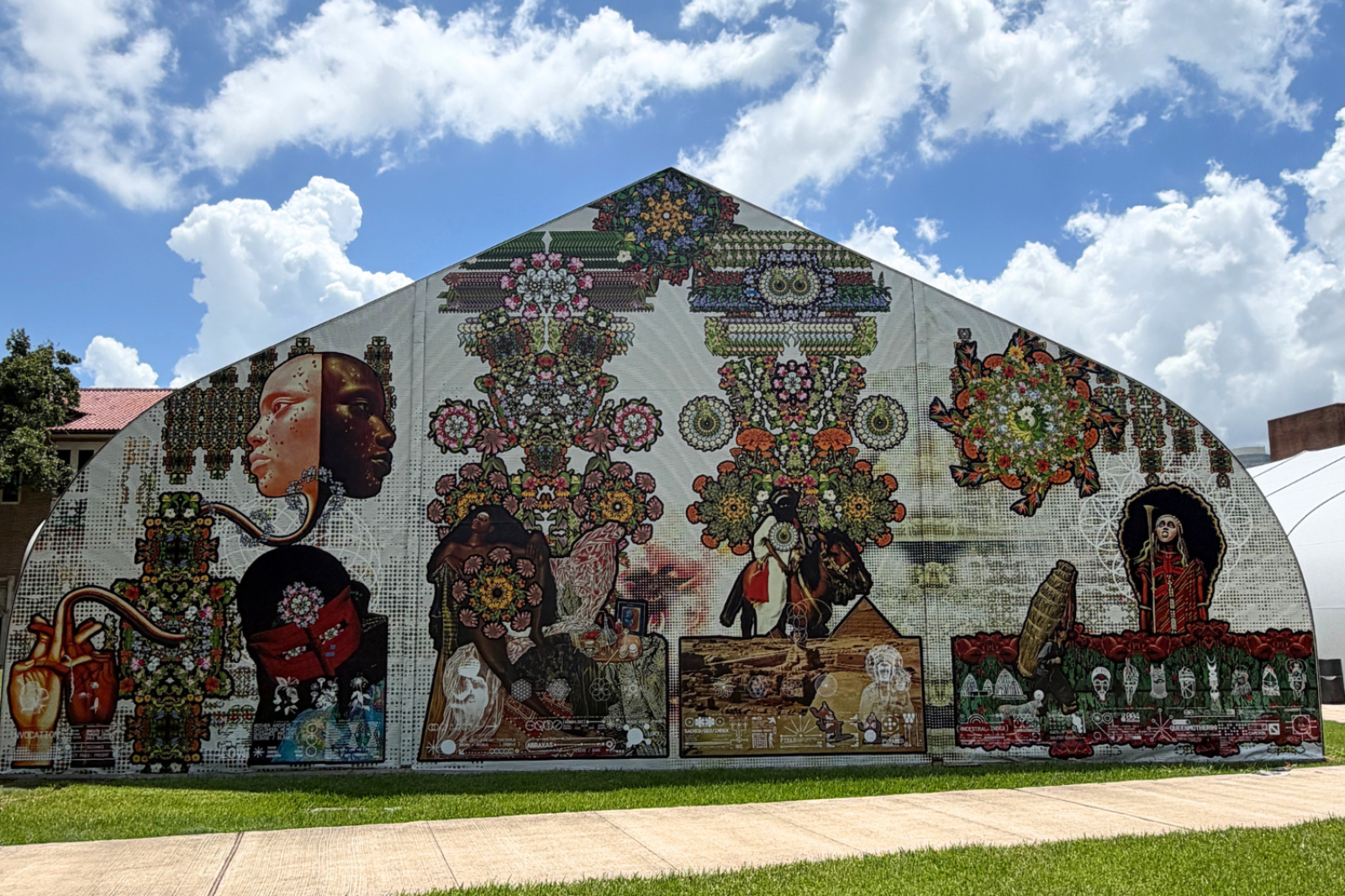
Floral Modulo, 2026
Printed vinyl, three oxidized steel sculptures
Commission, Moody Center for the Arts, Rice University
Preston Gaines’s practice unfolds through an ever-growing constellation of references drawn from his life, his passions and preoccupations, and the visual and cultural materials he encounters. Archival photographs, out-of-print publications, album covers, flowers, statistical data, and spiritual traditions are among these source materials, forming a deeply personal visual language through which he examines how individual experience becomes entangled with broader cultural histories.
For the Tents Series, Gaines translates this language into Floral Modulo, an installation extending across the tent façade and surrounding lawn. Four interconnected fields—Invocation, Altar, Passage, and Witness—progress across the façade, each rooted in different symbolic associations. Invocation centers on a masked woman from a National Geographic photograph; Gaines identifies her with his late mother, framing the figure as an ancestral guide. Altar draws from the cover of Santana’s Abraxas (1970), which reproduces Mati Klarwein’s painting Annunciation (1961);), a psychedelic reimagining of the biblical scene. Gaines reads its seated subject as both a former lover and himself, holding the duality between feminine and masculine within a single body. Passage places a rider from the Tuareg—an Indigenous people of the Sahara—within a landscape of Egyptian monuments and sacred geometry, a scene through which Gaines considers how culture and memory travel across places and generations. And Witness borrows from another Klarwein painting used as the album art for Miles Davis’s Bitches Brew (1970). Gaines links its standing figure with his daughter, positioning her as a counterpart to the matriarch in Invocation and signifying the rising generation’s charge to histories forward. Across the four fields, these figures operate as archetypes through which Gaines’s life opens onto universal themes of grief, love, change, and legacy. that resonate well beyond his individual experience.
Flowers are a recurring motif throughout Gaines’s practice and serve as a connective structure within the installation. Floral patterns stack across the façade and frame each of the four fields, while three steel sculptures extend these forms into three dimensions within the surrounding landscape. Based on black-eyed Susans, marigolds, cherry blossoms, and others, the flowers correspond in part to Houston’s Black, Latino, and Asian communities, situating the work within the diverse fabric of the city where Gaines lives and works.
Floral Modulo brings images separated by culture, geography, and time into a shared visual world. Through his dense layering of references, Gaines invites us to consider how we understand ourselves as individuals and in relation to the communities, histories, and relationships that shape us.
About the Artist
Preston Gaines (b. 1990) is a Houston-based artist, architect, and designer whose interdisciplinary practice encompasses installation, sculpture, and spatial design through a wide range of media. His work has been exhibited throughout Houston at Contemporary Arts Museum Houston, Blaffer Art Museum, Project Row Houses, Buffalo Bayou Partnership, and the University of Houston, as well as at the Contemporary at Blue Star, San Antonio, TX, among others. His awards and grants include a 2026 Idea Fund grant, administered by DiverseWorks in partnership with Aurora Picture Show and Project Row Houses, Houston. Gaines holds a BS in Architecture and an MArch from Prairie View A&M University, TX, and has served as a Visiting Adjunct Professor of Architecture at the University of Houston, TX.
This installation is organized by Claudia Mattos, Associate Curator, and made possible by the Moody Center for the Arts Founders Circle.
Dario Robleto
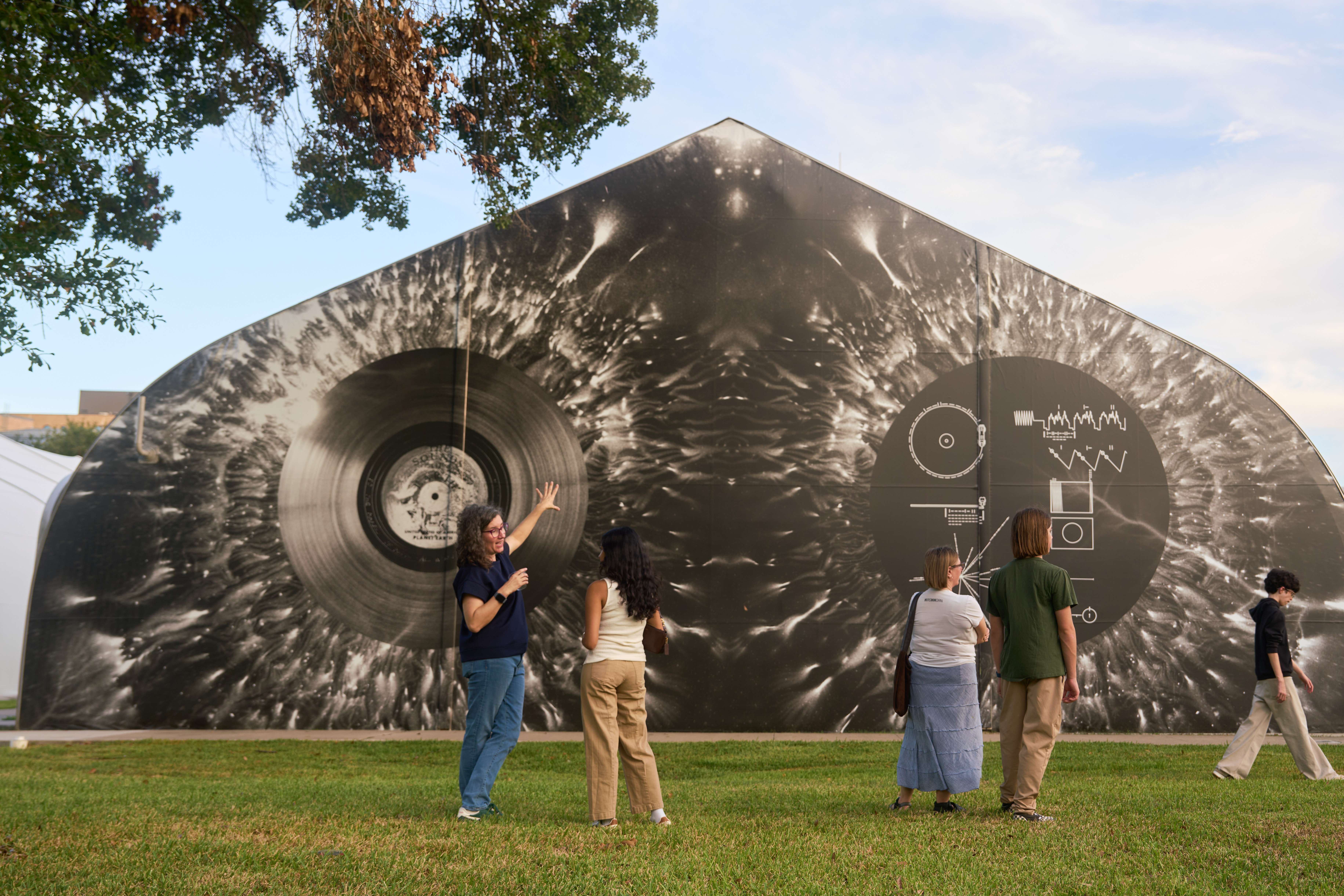
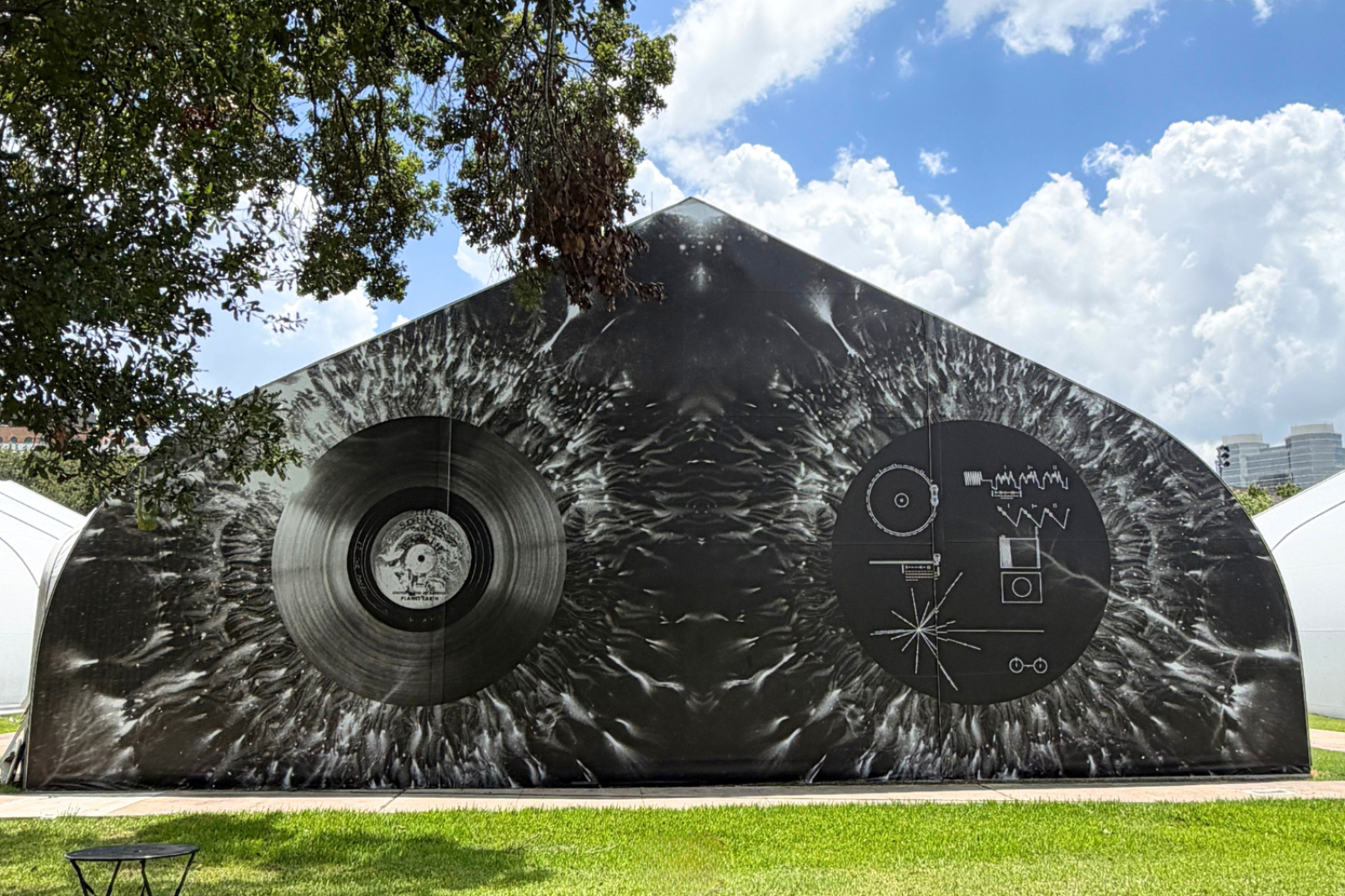
Ancient Beacons Long for Notice (film still), 2024
Original work: UHD video, 71:00 min. Commissioned by the Amon Carter Museum of American Art and the Santa Barbara Museum of Art.
Throughout his thirty-year career, Dario Robleto’s artistic practice has sought to cultivate rigorous, mutually transformative interactions between the arts, humanities, and sciences. Over the past decade, this effort has focused on two intertwined technological histories with deep philosophical and emotional implications: the search for extraterrestrial life and the quest to record the “signals” of the human heart and brain. These parallel inquiries are expressed in Ancient Beacons Long for Notice, the final film in a trilogy that centers on the Golden Record—two gold-plated phonograph records affixed to NASA’s Voyager 1 and Voyager 2 spacecraft. Launched in 1977 to explore the outer solar system, the spacecraft are now venturing toward interstellar space. Embedded in their grooves are numerous sounds, languages, musical recordings, and images chosen to portray the diversity of life and culture on Earth. They also hold the compressed brainwaves and heartbeat recordings of a twenty-seven-year-old woman who had just fallen in love. Their protective covers are inscribed with symbols that provide instructions for playing their contents, locating Earth, and dating their journey in space.
Created by a team of scientists led by astronomer Carl Sagan, the Golden Record was a hopeful gesture, carefully curated to present humanity’s “best face forward” in a first-contact scenario with other intelligent life; any traces of war, famine, or environmental devastation were intentionally omitted. Robleto’s film examines the implications of this ethos through new research on a forgotten document: the earliest audio recording of warfare, made in 1918 on the Western Front of WWI. After learning of this recording, Ann Druyan, the Golden Record’s creative director, sought to complicate NASA’s carefully edited portrait of humanity.
While connected to an electrocardiogram and electroencephalogram, Druyan recorded her heart’s electrical activity and brain waves as she reflected on suffering, injustice, and falling in love. This intimate human trace, shaped by her longing to connect and her reflections on tragedy, becomes a poetic gesture that reverberates across time and space. Ultimately, Robleto’s film asks: “What is our moral obligation to fully account for our actions—the good and the bad—in perpetuity, off-planet, and to beings we have yet to confirm exist?” In restaging this recording as a possible interstellar transmission, the film treats vulnerability itself as evidence worth preserving, rather than a truth to be edited out.
About the Artist
Dario Robleto (b. 1972) is a Houston-based artist whose interdisciplinary practice draws on the arts, humanities, and sciences. He has presented his work in solo exhibitions at the Menil Collection; Amon Carter Museum of American Art, Fort Worth; Santa Barbara Museum of Art; Block Museum of Art, Northwestern University; and the Baltimore Museum of Art. Select group exhibitions include the National Gallery of Art, Washington, D.C.; Hammer Museum, Los Angeles; and Centre Pompidou, Paris. His work is held in the collections of the Harvard Art Museums; Los Angeles County Museum of Art; Seattle Art Museum; Museum of Fine Arts Houston; and the Whitney Museum of American Art, New York. He has held positions as an artist-in-residence, research fellow, and lecturer at several institutions, including the Smithsonian’s National Museum of American History, the Massachusetts Institute of Technology, and the SETI Institute, among others.
This installation is organized by Noor Alé, Associate Curator, and made possible by the Moody Center for the Arts Founders Circle.