


Artists-in-Dialogue: Eamon Ore-Giron, Lori Boornazian Diel, Steven Gullberg
Join the Moody for our signature series, Artists-in-Dialogue, featuring exhibiting artist Eamon Ore-Giron. Every season, we host a conversation between an artist and researchers from complementary fields. Partnering with the faculty at Rice University and abroad, Artists-in-Dialogue facilitates new entry points for exploring art and reveals cross-disciplinary connections that illuminate the intersections of science and the humanities.
This fall, Ore-Giron, who is represented in Radiant Geometries: Vectors of Knowledge from the Indigenous Americas and the Rice Public Art Collection, will be in discussion with Lori Boornazian Diel, L.H. Favrot Professor of Humanities in the Department of Art History at Rice University, and Steven Gullberg, Professor of Cultural Astronomy at the University of Oklahoma.
Ore-Giron's visual language draws, in part, from astral charts and pre-Colombian/Andean traditions of sky-watching, creating a geometric and mathematical mode of abstraction that centers ancient systems. Diel and Gullberg will expand that exploration through the lens of art history and astronomy, evoking questions of how humans encode celestial observations and the passage of time.
More about the participants:
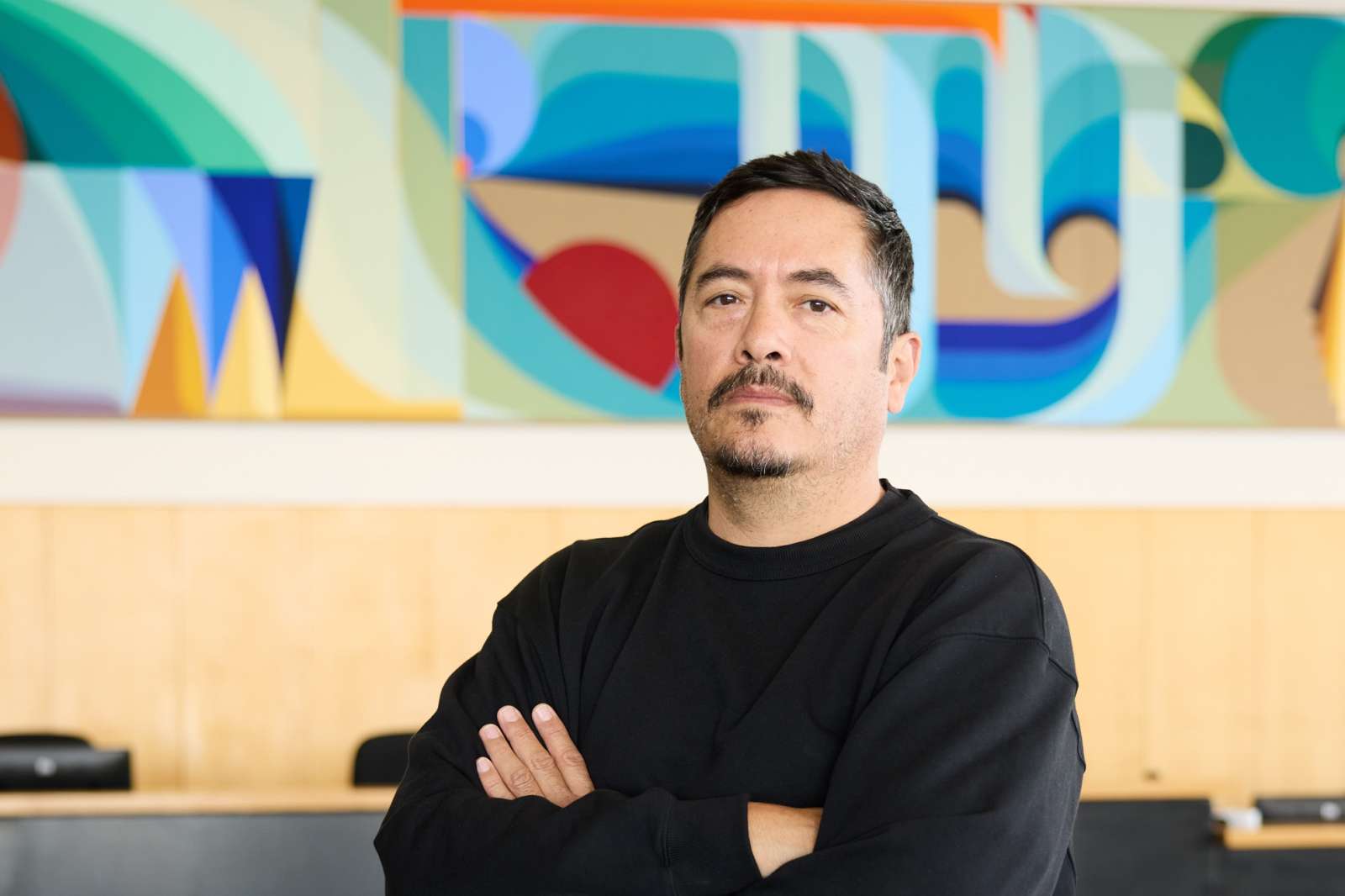
Eamon Ore-Giron (b. 1973, Tucson, AZ; lives in Los Angeles, CA) creates paintings, videos, and music that are informed by his experiences living across multiple locations, including Los Angeles, Mexico, Peru, and Tucson. Throughout these interconnected pursuits, the artist synthesizes formal histories to explore the visual, auditory, and experiential possibilities of cross-cultural influence. Ore-Giron is best known for his abstract geometric paintings, which hint at the visual languages of astral calendars, celestial bodies, textiles, maps, and architecture. These works display one of the hallmarks of Ore-Giron's practice: the process of cultural transmutation, or the migration of ideas, histories, and aesthetics across place and time.
Solo exhibitions of Ore-Giron’s work have been presented by The Contemporary Austin (2023); Museum of Contemporary Art Denver (2022); Anderson Collection at Stanford University (2022); and LAXART, Los Angeles (2015). Recently, he has participated in major group exhibitions and biennials such as Grounded at the Los Angeles County Museum of Art (2025-26); Bay Area Then at the Yerba Buena Center for the Arts (2025-26); Whitney Biennial (2024); Rising Sun: Artists in an Uncertain America at the Pennsylvania Academy of the Fine Arts, Philadelphia (2023); SOFT POWER at the San Francisco Museum of Modern Art (2019); and Made in LA at the Hammer Museum, Los Angeles (2018), among others.
Lori Boornazian Diel is the L.H. Favrot Professor of Humanities in the Department of Art History at Rice University. Her teaching focuses on the art of ancient and colonial Latin America, while her research considers how visual works created by Aztec artists in the years after the Spanish invasion and imposition of Hispano-Christian rule could be used as tools of persuasion, reconciliation, and identity formation under a colonial system. Her second book, The Codex Mexicanus: A Guide to Life in Late Sixteenth-Century New Spain (2018), was awarded the Roland H. Bainton Prize from the Sixteenth Century Studies Conference. Her most recent book, Aztec Codices: What They Tell Us about Daily Life (2020), uses images from Aztec codices to explain different facets of life in Aztec society. Diel has also published essays that consider specific Aztec pictorial manuscripts as well as the role of women in Aztec history. Her research has been supported by fellowships from the Dumbarton Oaks Research Library and Collection and the Wenner-Gren Foundation.
Steven Gullberg holds a Ph.D. in astronomy and is a Professor of Cultural Astronomy at the University of Oklahoma. He has a significant background in archaeoastronomy course development and serves as President of the International Astronomical Union’s Commission C5 for Cultural Astronomy. He is also Managing Editor of the Journal of Astronomy in Culture. He has conducted extensive field research on the astronomy of the Inkas in the Peruvian Andes and in addition to his books has written many research papers which he is regularly invited to present at international conferences as part of his work to globally advance the field of Cultural Astronomy.