




Carlos Cruz-Diez
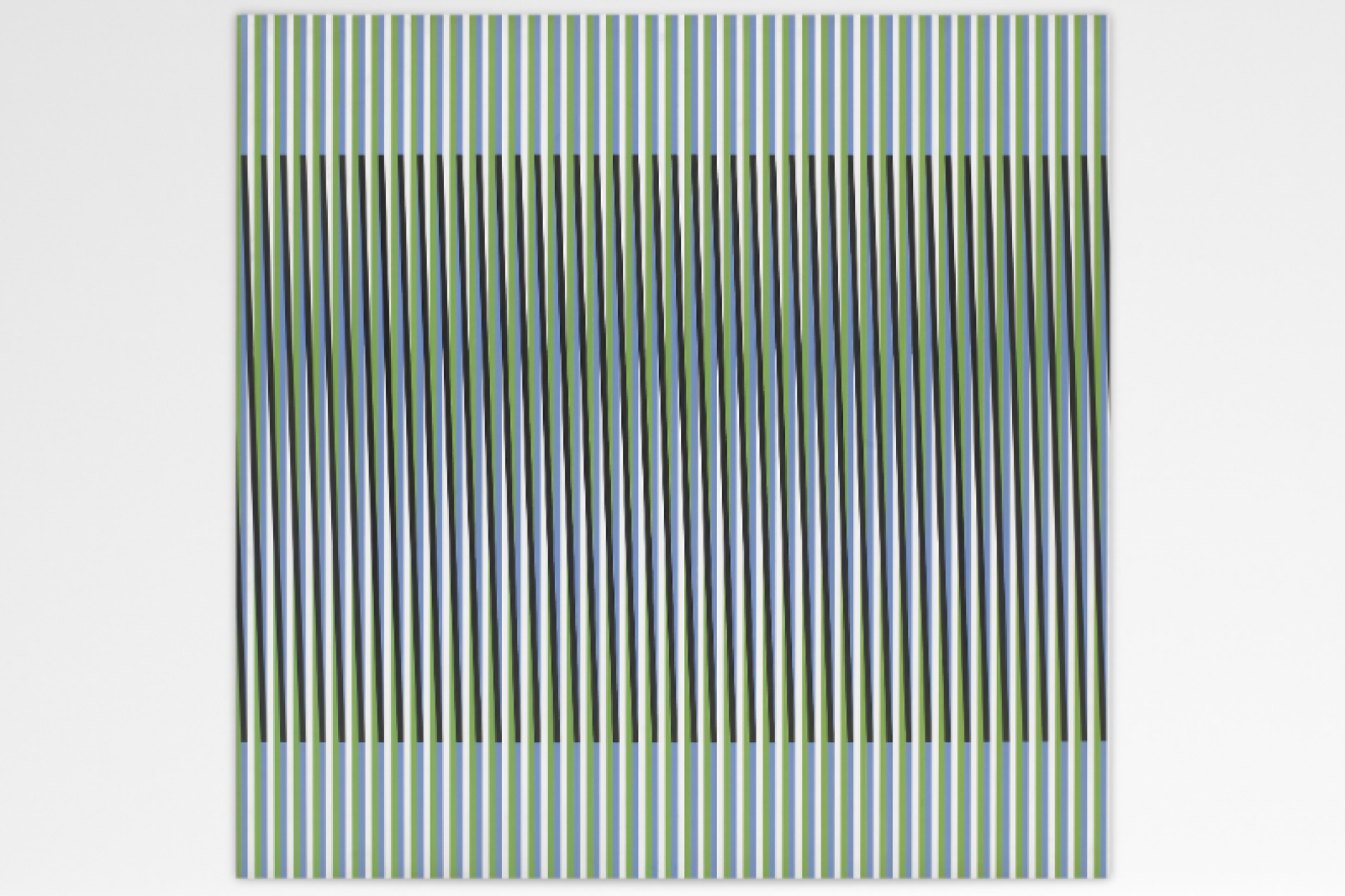
Inducción cromática serie B 4/4 [Chromatic Induction Series B 4/4], 1979
Acrylic on wood
Wiess House
Courtesy of the Carlos Cruz-Diez Foundation
French-Venezuelan artist Carlos Cruz-Diez (1923–2019) was a pioneer in the fields of kinetic and optical art, historical movements that encourage an awareness of the instability of reality. His lifelong fascination with light, as well as his interest in optical science, resulted in iterative experiments with visual perception through color and form.
Chromatic Induction Series B 4/4 explores retinal persistence, the phenomenon that the human brain retains an image for a moment after it disappears. The composition of alternating vertical bands of color, repeating at a slight angle, draws the eye across the canvas, creating a dynamic sense of movement. The optical nature of Cruz-Diez’s work and his fascination with the kinetic energy of color have resulted in his recognition as one of the most influential Latin American artists of the twentieth century.
About the artist: Carlos Cruz-Diez (b. Caracas, Venezuela, 1923, d. Paris, France, 2019) lived and worked in Paris. He studied art at the Escuela de Artes Plásticas y Artes Aplicadas de Caracas from 1940 to 1945.
His works are part of major public collections worldwide, notably the Museum of Modern Art (MoMA), New York; Tate Modern, London; Musée d’Art Moderne de Paris; Centre Pompidou, Paris; the Museum of Fine Arts, Houston; and the Wallraf-Richartz Museum, Cologne; among many others. Cruz-Diez’s works have been shown in numerous solo exhibitions, including (In)formed by Color: Carlos Cruz-Diez, Americas Society (AS), New York, NY (2008); Carte Blanche, Galerie Denise René, Paris, France (2007); Environment Chromatic-Interferences, Guangdong Museum of Art (GDMoA), Guangzhou, China (2010); Latin American Art, Hayward Gallery, London, England, and Nationalmuseum, Stockholm, Sweden (1989); among many others. In 2002, he was awarded the French medal, Commandeur de l'Ordre des Arts et des Lettres.